
Mr. Ioannis Loverdos, Deputy Minister of Foreign Affairs of Greece, met with Plato Academy’s board and executive leadership last Friday to examine how this Florida charter school network has become one of the most credible bridges between American students and Greece.
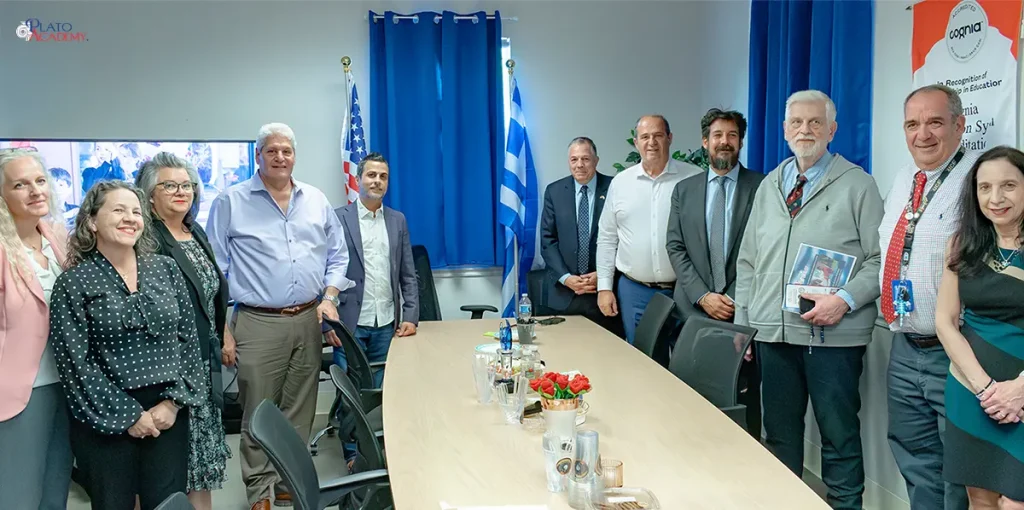
On Friday, March 27, 2026, Plato Academy Schools welcomed a distinguished guest: Mr. Ioannis Loverdos, Deputy Minister of Foreign Affairs of the Hellenic Republic. Present in the meeting was the Consul General of Greece in Tampa Mr. Constantinos Danassis, RI State Senator Leonidas Raptakis and his spouse Dona Raptakis.
Mr. Loverdos met with members of the Board of Directors, President Mr. Louis Kokkinakos, Vice President Mr. John Petalas, Secretary Mr. George Antonaklas and the Executive Leadership Team Chief of Schools Mrs. Amy Hayes, Director of Academics Ms. Danielle Cicetti, and Director of Staff Development Mrs. Dawn Parker, and the Director of Plato Academy School’s Greek program Mr. Konstantinos Aretis, to discuss the function, purposes, and mission of schools, and specifically, why institutions of this kind matter to Greece’s relationship with the global Greek diaspora.
The visit was a substantive conversation between Greek government leadership and the team steering one of the most distinctive public school networks in the United States.
A School That Does More Than Teach Greek
Plato Academy is a public charter school, and that distinction matters. Charter schools operate with greater autonomy than traditional public schools, drawing students from all backgrounds and zip codes. At Plato, that means children from families with no Greek heritage whatsoever are learning, singing, and thinking within a framework rooted in Hellenic culture.
Every school day begins the same way: students in their classrooms rise for the Greek national anthem, followed by the American national anthem. It is a quiet but powerful ritual that sets the tone for everything that follows.
The school’s approach to learning is Socratic at its core. Critical thinking, dialogue, and intellectual rigor are the foundation. Behavioral expectations follow the same philosophy, reinforced through the schools’ House System, which gives students a sense of identity, responsibility, and belonging within the larger school community.
Language as a Living Bridge
Greek culture at Plato Academy is academic currency. Students in seventh and eighth grade earn high school credit for their Greek language studies, credits that follow them forward when they enter high school. That decision reflects a deliberate philosophy: what students learn here should have real, lasting value in their academic careers.
The same thinking shapes the high school’s approach to college preparation. Rather than offering AP courses, Plato Academy has chosen dual enrollment, a model where students take actual college courses and earn credits that transfer automatically. The reasoning is straightforward: those credits count, no matter where a student enrolls after graduation.
What makes this even more significant is a linguistic fact worth stating plainly. Approximately 40 percent of the English language traces its roots to Greek. Students studying Greek at Plato are learning something that runs far deeper than a second language, they are unlocking the etymology of their own.
Encouraging Philhellenism, One Student at a Time
The results of this approach show up in ways that go beyond academic transcripts. Students speak about being genuinely moved by Greek culture. Alumni carry that connection into their adult lives. And the school has developed programs specifically designed to deepen ties between students and Greece itself.
Project Connect, the students’ trip to Greece, Olympic Games celebrations, and OXI Day commemorations are among the initiatives that give students direct, emotional contact with Hellenic history and identity. An alumni from Plato Academy of Clearwater (Panagiotis Stavrakos) represented Plato Academy at the Greek Youth Diaspora Symposium held in Athens in November of 2024, an experience that speaks for itself.
These are not peripheral activities. They are how Plato turns academic knowledge into genuine affinity, producing what could reasonably be called the next generation of philhellenes in America.
A Structural Challenge Worth Solving
The visit also surfaced a practical issue that deserves attention. Greece dispatches teachers to support Greek language instruction in diaspora schools, but those teachers typically arrive in November. Plato Academy, like most American schools, begins its academic year in August. That three-month gap often presents a challenge for the schools that try to set schedules and procedures for students and educators, as early as possible.
Why Sponsors and Supporters Matter
Sustaining programs that connect American students to Greece requires resources that go beyond a school’s operating budget. Sponsors who invest in Plato Academy’s cultural and exchange programs are funding a living relationship between two countries, one student at a time.
Plato Education Foundation Donations Page
Deputy Minister Loverdos’s visit was a reminder that this work is noticed and valued at the highest levels of Greek government. Plato Academy has built something genuinely rare: a public school where students from around the world are introduced to what Greece was, and to what Greece is today.
That is a mission worth supporting.
Plato Academy Schools is a network of public charter schools in the Tampa Bay area dedicated to academic excellence, Greek language instruction, and the development of well-rounded, civically engaged students.